
Getting to Know Our Wild Neighbours
Through our binoculars and through nature programs on television, we admire wildlife, but it’s at a distance. There’s a unique thrill in spotting a rare plant or helping a toad to safely cross the road.
Individuals and groups across Western Canada are finding ways to interact more closely with their wild neighbours through study and documentation, research, protection, and appreciation. Here are just a few examples.
Document
We need to know something exists before we can appreciate or protect it.
The Alberta Native Plant Council hosts annual weekend getaways to explore and document the local flora. Participants camp and join in a variety of field activities. In 2025, they visited the Beaver Hills Biosphere Reserve. June 12-14, 2026, the Council will be visiting Writing-On-Stone Provincial Park.
BC’s Fraser Valley Conservancy uses iNaturalist to collect information about the creatures that can be found on their properties. They’re collecting information on amphibians in the Fraser Valley and offer online training to help people identify suitable habitats for Oregon spotted frogs as part of their Precious Frog program that is working to recover the ecosystems that sustain amphibians all over the Fraser Valley. Their Three Creeks conservancy is a wildlife corridor in the increasingly developed McKee Peak region of Abbotsford. To find out more about the wildlife in this area, the Conservancy is asking residents of properties close to Three Creeks to submit their observations on iNaturalist.
Neighbourhood Bat Watch asks people to locate bat colonies and count the number of bats living in them to help monitor bat population trends.
Study
Franklin’s ground squirrels used to be common in central Alberta, but their reliance on dense shrub cover means they are now hard to find outside of provincial parks. Concerned about the decrease in the population, Nature Alberta and wildlife biologist Jessica Haines teamed up to collect data, hold outreach events, and try to determine what is causing the decline in the number of Franklin’s ground squirrels. Haines and her colleagues are looking for historical as well as current data to identify changes in habitat and food sources.
Raccoons are smart – very smart – but just how smart is the average urban bandit? In 2023, researchers at the University of British Columbia asked Vancouver residents to help them answer that question. Their goal was to reduce raccoon/human contact by developing more effective mitigation strategies. Residents were asked to volunteer their backyards so researchers could trap and tag raccoons. The researchers then set up night vision cameras so they could observe the raccoons undertaking a series of challenges “designed to assess spatial memory, learning, self-control and behavioural flexibility”.
From 2017 to 2019, Calgary residents were invited to submit their observations of amphibians in the city’s urban wetlands. Six amphibian species have historically been found in Calgary, but only 3 species – the boreal chorus frog, the wood frog, and the tiger salamander – were reported during the observation period.
Protect
Summit Lake near Nakusp is an important breeding site for the western toad, but they’re at risk during the 3 major migrations to and from the breeding area. Toadfest, held every August, offers displays set up by local environmental organizations and participants lend a hand in transporting frogs safely across the highway – 256 bucket loads of toads in 2025. (Handling wild animals requires specialized training and should only be undertaken as part of organized activities.)
Flowering rush is an invasive plant that invades wetland edges, displacing native plants, and killing the wetland. Volunteers and staff of the Saskatchewan Native Plant Society removed 877 bags of flowering rush over one weekend last year.
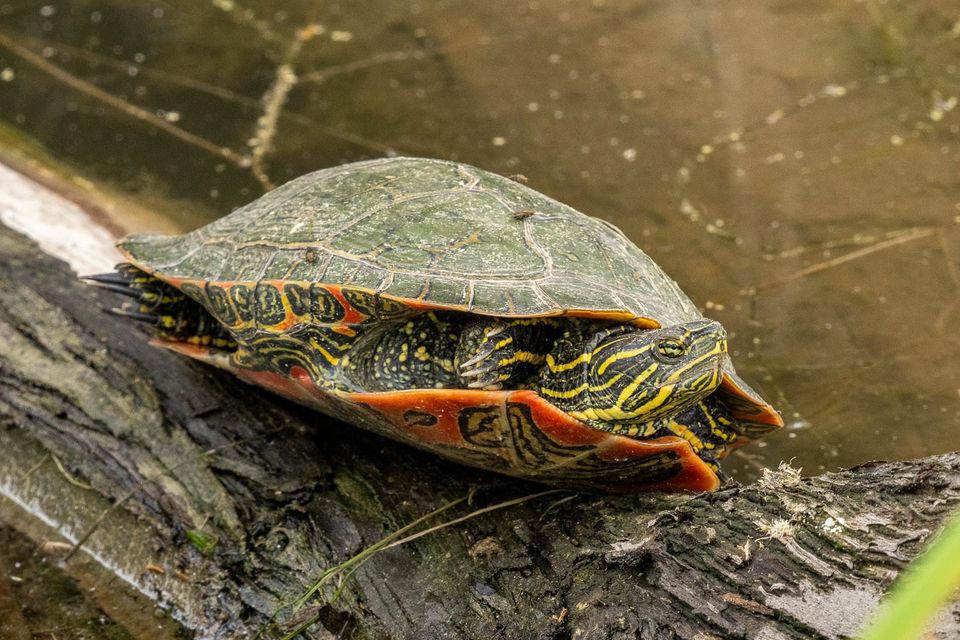
Western painted turtle nests are vulnerable to predation by raccoons and other wildlife. In Nanaimo, BC, volunteers patrol nesting sites at Buttertubs Marsh and Diver Lake during nesting season. When a nesting turtle is spotted, the volunteers wait until the female turtle has buried her eggs. They then place a protective cage over the site. The cage protects the eggs from predation, but the holes are big enough for the baby turtles to leave.
Celebrate
Winnipeg and area residents celebrate some small but mighty creatures that share their piece of the Earth.
There are live butterfly displays, a guided hike, a butterfly-friendly plant sale, and a milkweed plant giveaway at the Living Prairie Museum’s Monarch Butterfly Festival every summer.
Fort Whyte Alive celebrated National Moth Week at the end of July 2025 with a series of programs and workshops, including a bio-blitz, a guided walk, and a late-night light trap display.
Conclusion
We’re turning it over to you now. What projects and events are happening in your area? If you don’t know, a good place to start is by contacting your local nature or native plant society. If you have a specific area of interest, see if there is a group you can join such as Alberta and BC’s native bee associations or the various mycological organizations. You’ll find a list of provincial nature and environmental organizations on the EcoFriendly West website.
On an individual level, you can submit your observations to iNaturalist and NatureWatch.
Further Information
iNaturalist: Where Your Curiosity Contributes to Science [iNaturalist]
NatureWatch: Engaging Citizens in Science [NatureWatch]
Nature and Environmental Advocacy Organizations of Western Canada [EcoFriendly West]
The Raccoon Raiding Your Garbage Bin Might Just Be Solving a Puzzle — For the Fun of It [The Conversation]
Grounded in Action: Citizens and Scientists Unite to Help Franklin’s Ground Squirrels [North Saskatchewan Watershed Alliance]
Hunting for Fungi in Western Canada [EcoFriendly West]
Photo credit: https://www.flickr.com/photos/apmckinlay/54606506153
EcoFriendly West informs and encourages initiatives that support Western Canada’s natural environment through its online publication and the Nature Companion website/app. Like us on Facebook, follow us on BlueSky, X, and Mastodon, or subscribe by email.
Member discussion