
EcoWest News, April 28, 2026
Welcome to EcoWest News, a weekly round-up of news and resources that you can put to use in addressing environmental issues and protecting the wild in your community.
Biodiversity
For many years, conservationists focused on the overall number of animals remaining in a population. But this approach fails to take into consideration the knowledge, skills, reproduction, and immunity that older animals contribute to ensuring the survival of wildlife populations. [Yale Environment 360]
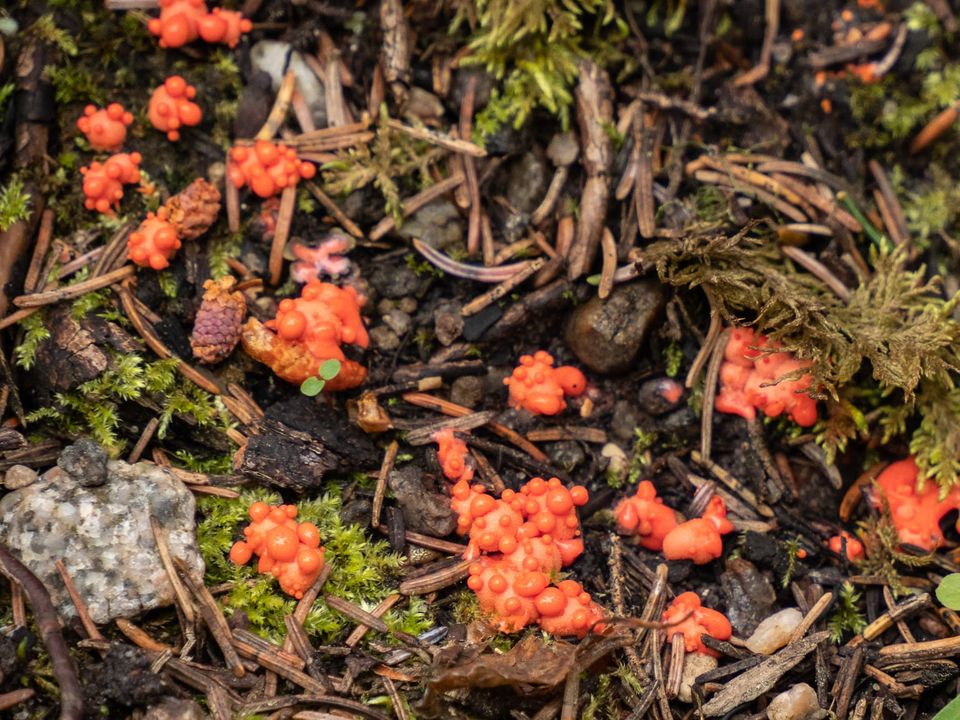
Tyson Ehlers, an amateur mycologist, has identified a new species of slime mould in the Slocan Valley, BC. He says, "If you spend enough time poking around under logs, you're going to see stuff … You notice patterns.” [CBC]
A Master’s student is looking at what we can do differently to support BC’s last population of northern leopard frogs whose annual migration takes them through active agricultural land. [Castanet]
Word choice and framing, such as good wolves and bad wolves or problem wolves, can have a major impact on conservation outcomes. [Sierra Club]
Birds
300 species of migrating birds rest and refuel at Last Mountain Lake Bird Sanctuary in Saskatchewan, North America’s first bird sanctuary. More than a third of the species will stay to nest. [Canadian Geographic]
The Upper Nicola Band marked 10 years of burrowing owl conservation efforts by releasing 11 captive-bred owls on their reintroduction site. [CBC]
Urban Living
Green Energy Futures has announced a series of podcasts profiling Canada’s best and most inspiring net-zero builders and renovators, beginning May 6. [Green Energy Futures]
The City of Victoria and the District of Saanich offer a Revitalization Tax Exemption (RTE) designed to encourage electrification of heating and hot water in large commercial, multi-unit residential, and mixed-use buildings. “Equity was an important part of the framing of the program – there are many incentives available for retrofits of single-family homes but we wanted to ensure that underserved demographics also benefit from climate action.” [Community Energy Association]
Researchers in Saskatoon are studying how green roofs can succeed in cold, dry conditions. [Global Institute for Water Security]
One of the biggest and oldest known communities of ground-nesting bees anywhere in the world makes its home in East Lawn Cemetery, Ithaca, New York. [Grist]
Shipping
As shipping increases in Arctic waters, Canada needs to prepare for oil spills and other pollution with shoreline vulnerability mapping, a better understanding of how oil moves and changes in Arctic coastal areas, and cleanup tools designed for the Arctic environment. [The Conversation]
Cruise ships run their diesel engines while docked. The Victoria harbour authority has backed away from adopting shore power, permitting ships to plug into the electrical grid. In contrast, the Port of Vancouver is moving ahead with two shore power connections, supported by community groups who continue to advocate for port upgrades. [Times Colonist, Strathcona Air Quality Study PDF]
Industry
The oil and gas industry, as well as deep underground mining such as potash extraction, is moving and injecting so much water they have become a more powerful geological force underground than natural processes. [The Tyee]
Making a Difference
A connection with nature is at the heart of everything Suzanne Simpson does as a teacher librarian at École Varennes and École Provencher in Winnipeg. She started environmental clubs and runs community gardens at both schools, and helped found Educators for Climate Action of Manitoba. [The Manitoba Teachers’ Society]
Nature’s Wonders
Rice seeds at optimum depths for germination can sense the sound of falling rain, indicating a favorable environment to start putting down roots. [Nautilus]
Large octopuses up to 19 metres long were among the top predators 100 to 72 million years ago, according to fossils found on Vancouver Island and in Japan. [The Guardian, CBC]
Photo credit: Red Raspberry Slime Mold https://www.flickr.com/photos/apmckinlay/51286795337
EcoFriendly West informs and encourages initiatives that support Western Canada’s natural environment through its online publication and the Nature Companion website/app. Like us on Facebook, follow us on BlueSky, X, and Mastodon, or subscribe by email.
Member discussion