
City Dwellers: Humans and Wildlife
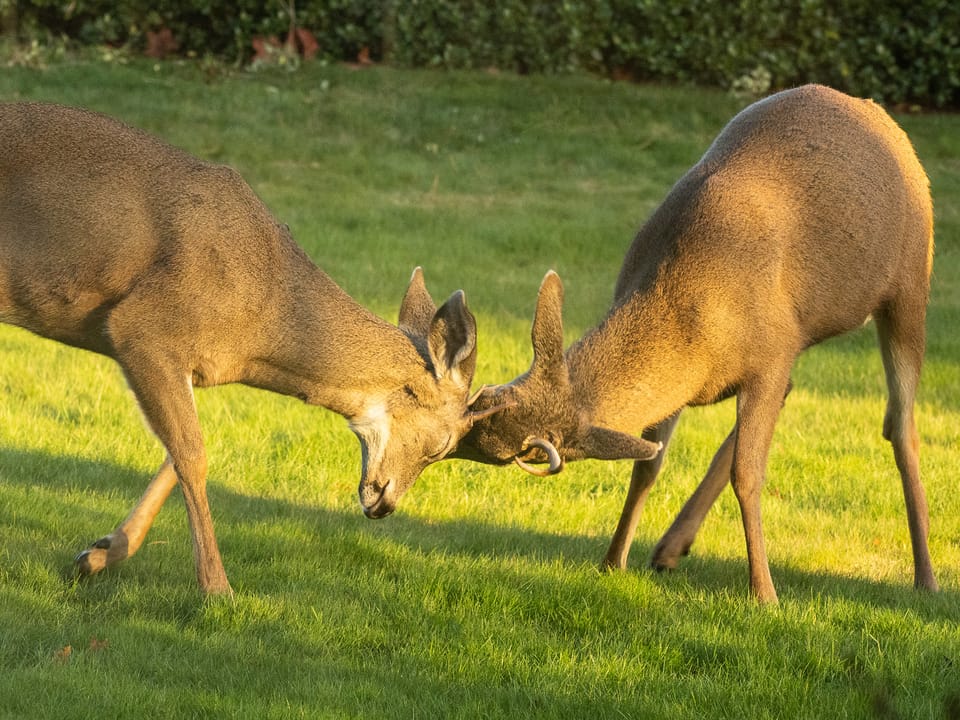
We know there are wild animals living alongside us in the city. Some of them delight us – the cheeky squirrel scurrying up a tree or an otter diving in the harbour. Others are more annoying – the deer eating all the tulip flowers or the Canada geese strewing poop in our parks. Some animals have a low profile and it’s only when researchers set up trail cameras that we really become aware of just how many wild animals make their home in the city.
Saskatchewan’s Urban Wildlife
A research team at the University of Saskatchewan, in collaboration with community partners, set up trail cameras in Saskatoon in 2019/20 as part of the Urban Wildlife Information Network (UWIN), the largest international study on urban wildlife. (The City of Edmonton, the University of British Columbia Urban Wildlife Project, and the University of Toronto are also UWIN partners.) The Saskatoon study showed that mule deer were living and raising families in the city, but white-tailed deer rarely left rural areas. All the animals captured on camera appeared healthy, so they were obviously finding food and resources with less competition than in rural areas. Most of the photographs displayed nocturnal activity whereas in the wild many of the animals, such as deer and foxes, would be most active at dusk, an indication that the animals were adapting to human activity, light, and noise pollution by becoming most active at night.
21 mammal species were spotted regularly (foxes, raccoons, coyotes), while others were only spotted occasionally. With 30 cameras over 3 years, the project recorded 249 photographs of moose. 15 or 20 years ago, moose wouldn’t have been spotted in Saskatoon, but the animals are taking advantage of patches of wetland and pulse crops growing nearby. Young male moose wander into the city during breeding season when the females are preparing for newborns and have sent last year’s young off to fend for themselves.
The Royal Saskatchewan Museum and the University of Regina set up 28 trail cameras and acoustic recorders inside and outside city boundaries in 2021. Their baseline data collection is now complete, but they’ll be monitoring the sites every 3-5 years to observe changes. The highest number of bird species were found in low-density urban areas. Species that rely on planted tree cover (fox squirrels, merlins, and red-breasted nuthatches) were more frequent in areas with greater than 40% urbanization.
The number of mammal species observed remained constant across low, moderate, and high urbanization sites, but some species responded negatively to urbanization. There were fewer photos of white-tailed deer and coyotes at sites with greater than 40% urbanization. This also applied to several species of grassland- and wetland-associated birds (horned lark, western meadowlark, greater yellowlegs, yellow-headed blackbird).
Deer in Oak Bay
It’s not easy sharing space with other species, both for wildlife and humans, and it requires adaptability from both parties.
Oak Bay in Greater Victoria is a case in point. In 2016-2018, the black-tailed deer population increased noticeably in the community and people weren’t happy. The deer were eating their flowers, causing road accidents or near misses, and occasionally attacking their dogs. The municipality initially instituted a cull, but it had no lasting impact on the deer population and there was a public outcry.
The next step was to introduce a contraceptive program, leading to a significant reduction in the number of fawns. Does participating in the program had collars so residents could recognize individual deer and people became much more tolerant: “They realized that was ‘Alice’ just going by over and over and over again … They quickly came to realize that it’s not 500 deer in Oak Bay. It’s actually about 120.” Residents started to fence their gardens or plant deer-resistant species. A neighbourhood group started distributing signs that could be set up when young fawns were in the area so drivers could watch out for them on the roads.
Edmonton Coyotes
Urban coyote populations have been increasing over the past 20 years, and they can now be found in cities right across North America. The Edmonton Urban Coyote Project has been investigating the causes and solutions for human-coyote conflict since 2018. Their goal is to promote successful coexistence that will maximize the ecological benefits of coyotes (e.g. control of prey species, scavenging of carrion, dispersal of plant seeds) and minimize the need for lethal management while still protecting people and their pets.
Both coyotes and rodents are attracted to birdseed found underneath backyard bird feeders. A recent study found that coyotes more frequently visited feeders offering sunflower seeds rather than mixed seed, so it may be possible to discourage coyotes by providing less attractive feed. However, the most effective approach is to remove all accessible sources of food.
Over a two-year period, local residents and researchers in Edmonton neighbourhoods with repeated coyote sightings conducted coyote patrols and, when warranted, conducted aversive conditioning of bold coyotes. The hazing caused coyotes to retreat although it didn’t appear to change their subsequent behaviour. It did, however, reassure members of the public and emphasized “the rarity of close encounters with coyotes and the high frequency with which they retreat from human approaches and even directed attention by people.
Note: Information about the Regina research project was provided by Dr. Ryan Fisher, Royal Saskatchewan Museum
Further Information
“You Don’t Have to Leave the City to Connect with Urban Wildlife” [EcoFriendly Sask]
Urban Wildlife Information Network [UWIN]
Urban Wildlife Stewardship Society [UWSS]
Urban Deer [District of Oak Bay]
When Marmots Haunt Your Cemetery, What to Do? From Coyote Urine to Deer Birth Control, Merritt and Other BC Towns are Forsaking Wildlife Culls for Other Fixes [The Tyee]
The Edmonton Urban Coyote Project [The Edmonton Urban Coyote Project]
How Geography and City Planning Have Made Edmonton a Beacon for Urban Wildlife [CBC]
Photo credit: https://www.flickr.com/photos/apmckinlay/52525610891
EcoFriendly West informs and encourages initiatives that support Western Canada’s natural environment through its online publication and the Nature Companion website/app. Like us on Facebook, follow us on BlueSky, X, and Mastodon, or subscribe by email.
Member discussion